
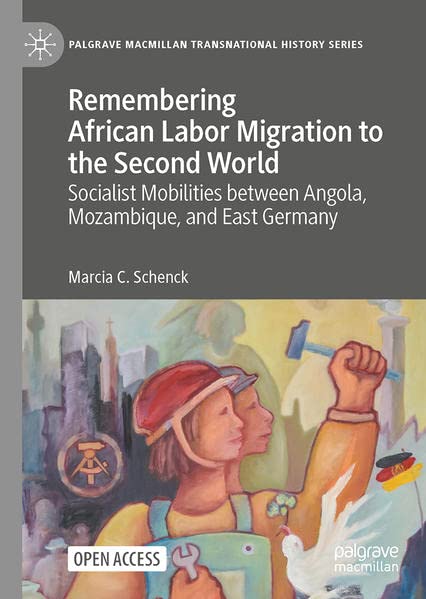
Remembering African Labor Migration to the Second World [electronic resource] : Socialist Mobilities between Angola, Mozambique, and East Germany / by Marcia C. Schenck.
Material type: TextSeries: Palgrave Macmillan Transnational History SeriesPublisher: Cham : Springer International Publishing : Imprint: Palgrave Macmillan, 2023Edition: 1st ed. 2023Description: XXVII, 377 p. 11 illus. in color. online resourceContent type:
 - text
- computer
- online resource
- 9783031067761
- 909 23
- D17-24.5
Chapter 1: Introduction -- Chapter 2: Between the Hammer, Machete, and Kalashnikov: Labor Migration from Angola and Mozambique to East Germany 1979-90 -- Chapter 3: Socialist Workers and Socialist Consumers -- Chapter 4: The Social Life of Socialism: Intimacy and Racism -- Chapter 5: Return, Fall and Rise of the Madjerman: The Afterlives of Socialist Migration -- Chapter 6: Temporality, Memory and Meaning: Eastalgia in Angola and Mozambique -- Chapter 7: Epilogue: Transnational Sojourners, Intimate Strangers, and Workers of the World.
Open Access
This open access book is about Mozambicans and Angolans who migrated in state-sponsored schemes to East Germany in the late 1970s and throughout the 1980s. They went to work and to be trained as a vanguard labor force for the intended African industrial revolutions. While they were there, they contributed their labor power to the East German economy. This book draws on more than 260 life history interviews and uncovers complex and contradictory experiences and transnational encounters. What emerges is a series of dualities that exist side by side in the memories of the former migrants: the state and the individual, work and consumption, integration and exclusion, loss and gain, and the past in the past and the past in the present and future. By uncovering these dualities, the book explores the lives of African migrants moving between the Third and Second worlds. Devoted to the memories of worker-trainees, this transnational study comes at a time when historians are uncovering the many varied, complicated, and important connections within the global socialist world. Marcia C. Schenck is professor of Global History at the University of Potsdam, Germany. Her research interests include global and African history, oral history, labor and education history, and migration history. Her peer-reviewed articles have appeared in Africa, African Economic History and Labor History, among others. She recently co-edited a volume about the varied relationship between East Germany and the African continent called Navigating Socialist Encounters: Moorings and (Dis)Entanglements between Africa and East Germany during the Cold War (De Gruyter, 2021). She is co-founder of the H-Net Refugees in African History network and the founder of the Global History Dialogues, which constitutes part of Princeton University’s Global History Lab.
There are no comments on this title.